Craft & Fabrication
-
Dimensions: 55cm x 55cm (22" x 22")
- 100% polyester case
- Fabric weight: 8.1 oz./yd.² (275 g/m²)
- Linen feel fabric
- Hidden zipper
- Machine-washable case
- Shape-retaining 100% polyester insert included (hand-wash only)
Modern Translation:
Opting for slightly subtler, deeper hues, this iteration delivers a highly intricate but deeply grounded aesthetic. Placed in a softly lit, neutral-toned room, the incredibly complex geometry of the Persian Boteh provides a highly mature, meditative, and luxurious focal point.
Journey to 15th-Century Kashmir
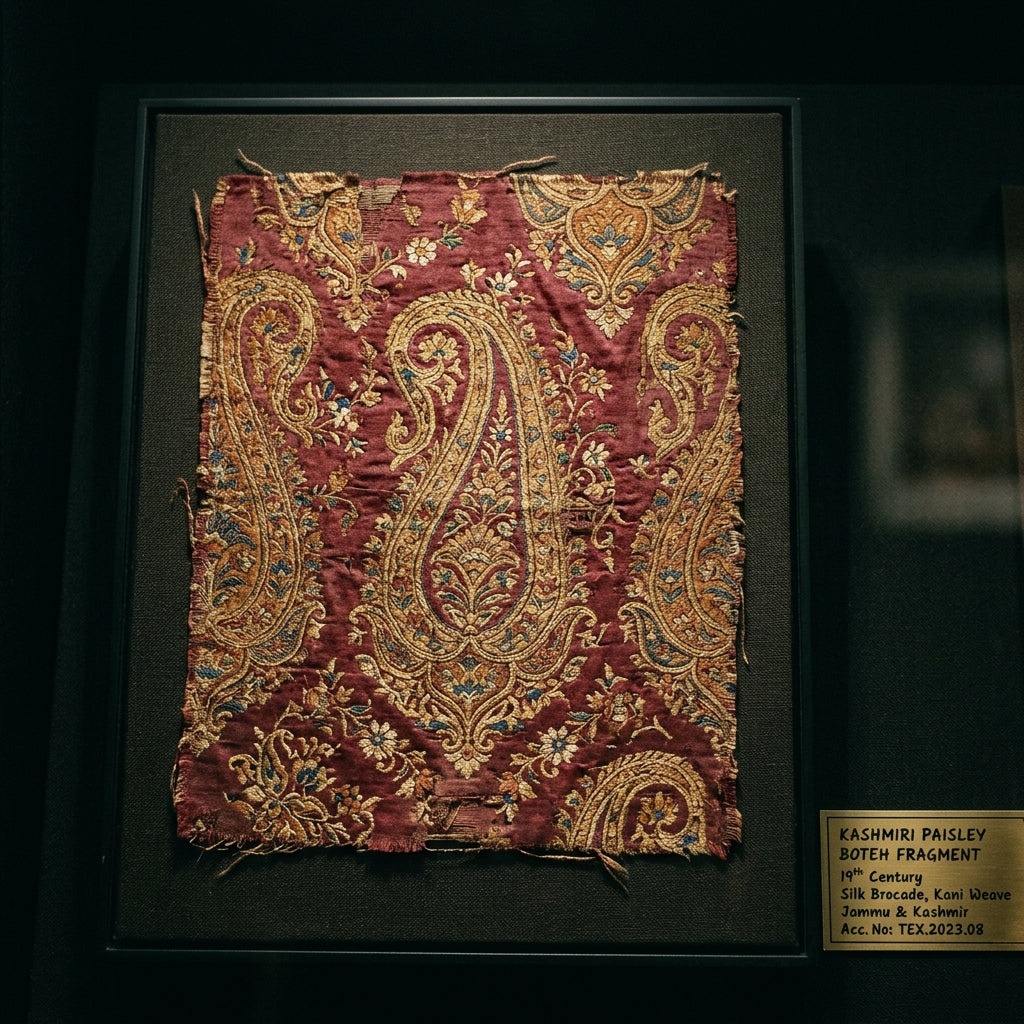
If you look at this dense, curved teardrop shape, you probably call it "paisley." But to truly understand this pattern, we have to look past Western names and travel back to the 15th century. Our story begins in Kashmir, a mountainous region located at the very northern tip of India, nestled deep within the freezing altitudes of the Himalayas. Around the year 1420, a ruler named Sultan Zain-ul-Abidin took power. He was obsessed with the arts of neighboring Persia (modern-day Iran) and brought Persian weavers across the mountains into Kashmir. They brought with them a distinct motif called the "boteh"—the Persian word for a flower bud or a shrub.
The Zoroastrian Cypress Tree
An authentic, historical boteh is characterized by a dense floral shape that bends sharply at its top. This wasn't just a randomly drawn squiggle. Its earliest roots tie directly back to the ancient Persian religion of Zoroastrianism. In Zoroastrian belief, this shape was meant to represent a bending cypress tree. Unlike other trees, the cypress is an evergreen, meaning it survives the brutal winters without dying. This made it a powerful, universally understood symbol of eternal life, resilience, and fertility. When you see this motif, you aren't just looking at a plant; you are looking at an ancient symbol for immortality.
The Mastery of Pashmina Goat Hair
By the 16th and 17th centuries—during the height of the grand Mughal Empire in India—this pattern had become a symbol of extreme wealth. The craftsmen in Kashmir didn't weave these designs using heavy cotton or cheap wool. They used pashmina, an incredibly fine, microscopic hair naturally shed by goats living high in the freezing Himalayan mountains. Weaving the incredibly dense floral details of the boteh motif using hair that thin was brutally slow. Working entirely by hand on wooden looms, it could easily take a family of weavers three entire years to finish a single masterpiece shawl.
The Color Code of the Silk Road
Authentic pieces from this era are defined by their incredible density and deeply saturated colors. To make sure the tiny intertwining vines and packed flowers were visible, the historical dyers had to invent intense, jewel-toned colors. They used brilliant indigo blues and deep reds extracted from the roots of the madder plant. These dyes were fiercely guarded chemical secrets. When these vibrant, teardrop-covered shawls began traveling back to Europe via the famous Silk Road trading routes in the 1700s, they became the ultimate, outrageously expensive status symbol for European aristocrats.
How 'Boteh' Became 'Paisley'
So, why do Americans call a 15th-century Asian symbol "paisley"? By the early 1800s, the demand for these Kashmir shawls in Europe was so impossibly high that Western manufacturers decided they needed to copy them. Rather than spending three years hand-weaving a single piece, the industrial town of Paisley, Scotland, used newly invented mechanical Jacquard looms to mass-produce cheap imitations by the thousands. The town of Paisley cranked out so many of these knock-offs that Westerners simply forgot the original Persian name. Today, when you trace the curve of this teardrop, you are looking at a 600-year-old symbol of eternal life that was stolen, mass-produced, and renamed by the Scottish textile industry.
The Psychedelic Revolution of the 1960s
While the paisley pattern had been mass-produced into a cheap European commodity in the 1800s, it experienced a massive, explosive resurrection during the 1960s "Summer of Love." The swirling, interlocking shapes of the boteh became the absolute defining visual language of the psychedelic rock movement. As Western youth rejected the rigid, clean-cut minimalism of the 1950s, they sought out Eastern mysticism and mind-expanding aesthetics. Cultural icons like The Beatles spearheaded this revival, wrapping themselves in heavily patterned, wildly vibrant paisley shirts during their intense experimental phase, permanently cementing the ancient boteh as a symbol of bohemian counter-culture.